



Working his way to recovery
For Rod ‘Dude’ MacDonald of Maple Hill, June 30, 2011, was just a regular work day at Atlantic Enterprise until “one little move caused me to put my life on hold.” MacDonald was in the bucket of his utility truck, when he slipped on the deck. What he initially thought was a groin pull was actually a severe labral tear that resulted in hip surgery and months of rehabilitation.
MacDonald, who is also a distance runner and East River’s Fire Chief, was highly motivated to get back to work. Being unable to perform any type of physical work and staying at home “drove me pretty near batty and drove my wife nuts,” he said.
With the support of his employer, Thane Myers, and his Workers Compensation Board (WCB) Occupational Therapist, Cathy Callaghan, MacDonald was able to return to Atlantic Enterprise to help with administrative work while awaiting surgery. Although the indoor desk job was not a natural fit for this physically active outdoorsman, he reported that his modified work allowed him to make a valuable contribution to the company and stay connected to his workplace.
After his surgery in February, MacDonald was ordered to stay home and off his feet for at least eight weeks, or risk a permanent limp. Then he began a regime of physical therapy to help build strength in his hips and legs. By August, he was strong enough to incorporate an easeback program as part of his recovery process.
The purpose of an easeback is to build strength and tolerance so that an injured worker can gradually resume full duties and regular hours. An easeback program is developed by an occupational therapist, who considers ergonomics and injury prevention to enable people to participate in activities that contribute to their health and well-being. Occupational Therapist Cathy Callaghan worked in collaboration with MacDonald, his employer and his health care providers, to develop a customized program to assist him in returning to work in a safe and timely manner.
“Rod’s positive attitude and active participation in every aspect of his rehabilitation - whether it was immobilization, physiotherapy or his easeback to work - were the keys to his success,” said Callaghan.
MacDonald’s easeback program started with reduced hours and the lighter duties of his job, including truck driving and operating the excavator. He worked with a colleague to complete the jobs that were beyond his capabilities at the time.
“At first, I thought I could get right back into work, but I couldn’t believe how sore I was after the first few hours back,” said MacDonald. The physical activities of the easeback program safely conditioned his body to become adjusted to work.
Because MacDonald’s job can be different each day, he worked with Callaghan to constantly tailor his easeback program, ensuring that he was able to be as productive as possible in a way that contributed positively to his recovery. MacDonald was able to return to his regular duties as of October 22, and although he is not back to running marathons yet, he plans to be. “I’ve gone further than I’ve ever thought I would,” he said.
“Mr. MacDonald’s story is an inspiration for anyone returning to work after an injury, because it demonstrates how injured workers, employers and occupational therapists can work together to promote recovery and achieve a successful return to work.” said Nancy Guptill, Chair of the Workers Compensation Board. “It is also an ideal way to celebrate October as Occupational Therapy Month, by showcasing the valuable role of our occupational therapists.”
For more information about returning to work after an injury, visit the Return to Work section of the WCB website, or contact us.
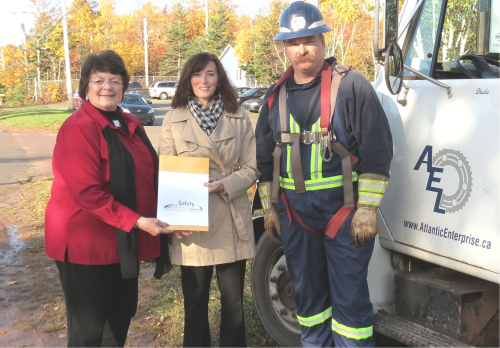
Rod ‘Dude’ MacDonald, (right,) returning to work as an Operator at Atlantic Enterprise Ltd., with Nancy Guptill Workers Compensation Board (WCB) Chair (left) and WCB Cathy Callaghan, Occupational Therapist.
WCB Communications
902-894-0362 or news@wcb.pe.ca